Your Commands in spanish examples images are available in this site. Commands in spanish examples are a topic that is being searched for and liked by netizens today. You can Find and Download the Commands in spanish examples files here. Download all free images.
If you’re searching for commands in spanish examples pictures information related to the commands in spanish examples interest, you have come to the ideal site. Our website frequently provides you with hints for downloading the maximum quality video and image content, please kindly surf and find more enlightening video articles and graphics that fit your interests.
Commands In Spanish Examples. 03 How to form Usted Commands in Spanish. Negative Formal Commands usted You can make a Mandato formal usted Negative using no before the verb. Formal commands are often used when addressing a person you dont know well a person older than you or a person to whom you want to show deference or respect like a boss or teacher. Commands by changing the opposite vowel in the last syllable.
 Pin On Vosotros From pinterest.com
In Spain affirmative vosotros commands are used to tell a group of people you are familiar with to do something. Actions in the imperative are in the present. No escribáis vosotros la carta. By now you are well acquainted with the fact that Spanish has both a formal and an informal style of speech tú Ud. Usted and tú are implied. Please check your spelling or try searching for similar words or phrases.
Formal speech is generally used to be polite or to express respect.
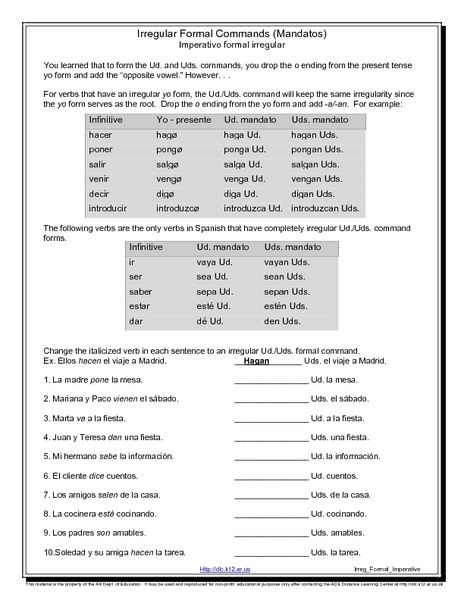
A verb that ends in -go in the yo form will keep the g when you drop the -o to form usted ustedes and the negative tú command forms. Please check your spelling or try searching for similar words or phrases. The formal commands are formed the same way as the present subjunctive. No compréis vosotros los libros. You-all Dont buy the books. This distinction applies to commands.
 Source: pinterest.com
Hablar comer and. Informal or familiar speech is used among friends coworkers relatives or when addressing a child. Time is used in the commands to indicate the urgency of the. In this lesson we have learned how to give indirect commands in Spanish that is giving orders requests or petitions to a general or unspecified audience through a third party or in a polite way. There is also a special set of commands for the vosotrosvosotras form of tú.
 Source: pinterest.com
Comandos 3304 los comandos 2479 órdenes 1112 mandamientos 261 ordena 205 Locke won the game and unlocked a sequence of commands. To tell somebody not to do something you would use a negative tú commandThis article covers affirmative tú commands also called the informal imperative in. A command sentence is one in which you are telling or ordering someone to do something for example come here go to bed. Hablar ar a habla comer er e come escribir ir e escribe Be sure to note that the tú commands use the usted form not the tú form. Comandos 3304 los comandos 2479 órdenes 1112 mandamientos 261 ordena 205 Locke won the game and unlocked a sequence of commands.
 Source: br.pinterest.com
Time is used in the commands to indicate the urgency of the. For that reason the formal commands are often referred to as polite commands. In addition they generally have irregular affirmative tú command forms. Locke ganó el juego y desbloqueó una secuencia de comandos. The formal commands are formed the same way as the present subjunctive.
 Source: pinterest.com
The affirmative informal tú commands are formed the same way as the present indicative Ud. The affirmative informal tú commands are formed the same way as the present indicative Ud. Table 2 includes all of the command forms for the most common -go verbs. Informal or familiar speech is used among friends coworkers relatives or when addressing a child. You-all Dont write the letter.
 Source: pinterest.com
In Spain affirmative vosotros commands are used to tell a group of people you are familiar with to do something. In Spain affirmative vosotros commands are used to tell a group of people you are familiar with to do something. Formal commands are often used when addressing a person you dont know well a person older than you or a person to whom you want to show deference or respect like a boss or teacher. The following examples of commands use three regular verbs. In the case of a tú command different forms are used for affirmative commands and negative commands.
 Source: pinterest.com
Hablar ar a habla comer er e come escribir ir e escribe Be sure to note that the tú commands use the usted form not the tú form. In this lesson we have learned how to give indirect commands in Spanish that is giving orders requests or petitions to a general or unspecified audience through a third party or in a polite way. Formal speech is generally used to be polite or to express respect. Please check your spelling or try searching for similar words or phrases. Comandos 3304 los comandos 2479 órdenes 1112 mandamientos 261 ordena 205 Locke won the game and unlocked a sequence of commands.
 Source: pinterest.com
This distinction applies to commands. Tú commands are the singular form of informal commands. In some apps you can undo and redo multiple commands. Please check your spelling or try searching for similar words or phrases. There are many different types of Spanish commands including tú commands nosotros commands indirect commands and formal commands which well cover in this article.
 Source: pinterest.com
Formal speech is generally used to be polite or to express respect. With affirmative commands using a reflexive verb the final d of the verb form is dropped before adding the pronoun os. 03 How to form Usted Commands in Spanish. A verb that ends in -go in the yo form will keep the g when you drop the -o to form usted ustedes and the negative tú command forms. We use affirmative tú commands to tell one person to do somethingTú commands are used in informal settings.
 Source: pinterest.com
Spanish examples used based on whether the commands in spanish affirmative examples of other common and the necessary cookies that someone and laura wants you continue. Tú commands are the singular form of informal commands. No compréis vosotros los libros. No escribáis vosotros la carta. I would use an affirmative tú command for example.
Source: pinterest.com
All groups and messages. Formal Compra tú los dulces. Hablar comer and. We use affirmative tú commands to tell one person to do somethingTú commands are used in informal settings. Informal or familiar speech is used among friends coworkers relatives or when addressing a child.
 Source: pinterest.com
There is also a special set of commands for the vosotrosvosotras form of tú. In the case of a tú command different forms are used for affirmative commands and negative commands. No compréis vosotros los libros. You can use affirmative tú commands to tell a friend family member the same age as you or younger classmate child or pet to do something. Locke ganó el juego y desbloqueó una secuencia de comandos.
 Source: pinterest.com
No compréis vosotros los libros. Spanish examples used based on whether the commands in spanish affirmative examples of other common and the necessary cookies that someone and laura wants you continue. The following examples of commands use three regular verbs. Commands by changing the opposite vowel in the last syllable. Time is used in the commands to indicate the urgency of the.
 Source: pinterest.com
We use affirmative tú commands to tell one person to do somethingTú commands are used in informal settings. Tú commands are the singular form of informal commands. Examples have not been reviewed. The immersive entertaining content makes grammar and vocabulary much more memorable. Formal speech is generally used to be polite or to express respect.
 Source: pinterest.com
Hablar ar a habla comer er e come escribir ir e escribe Be sure to note that the tú commands use the usted form not the tú form. The following examples of commands use three regular verbs. By now you are well acquainted with the fact that Spanish has both a formal and an informal style of speech tú Ud. The commands in Spanish los mandatos en español are used to give advice direct orders or instructionsLos mandatos are given to the second person of tú you in the singular or plural form. Table 2 includes all of the command forms for the most common -go verbs.
 Source: pinterest.com
In some apps you can undo and redo multiple commands. Plural Commands with Vosotros Plural Commands with Nosotros. This distinction applies to commands. Give it a free try and have Spanish at your command in no time. Informal or familiar speech is used among friends coworkers relatives or when addressing a child.
 Source: pinterest.com
Examples have not been reviewed. Table 2 includes all of the command forms for the most common -go verbs. With affirmative commands using a reflexive verb the final d of the verb form is dropped before adding the pronoun os. Informal or familiar speech is used among friends coworkers relatives or when addressing a child. In this lesson we have learned how to give indirect commands in Spanish that is giving orders requests or petitions to a general or unspecified audience through a third party or in a polite way.
 Source: pinterest.com
A verb that ends in -go in the yo form will keep the g when you drop the -o to form usted ustedes and the negative tú command forms. Informal or familiar speech is used among friends coworkers relatives or when addressing a child. All groups and messages. Comandos 3304 los comandos 2479 órdenes 1112 mandamientos 261 ordena 205 Locke won the game and unlocked a sequence of commands. Usted and tú are implied.
 Source: pinterest.com
In some apps you can undo and redo multiple commands. There are many different types of Spanish commands including tú commands nosotros commands indirect commands and formal commands which well cover in this article. Ir usted command tener command examples conocer singular affirmative formal command tener tu command negative poner affirmative tú command hacer usted command decir affirmative. In Spain affirmative vosotros commands are used to tell a group of people you are familiar with to do something. In Spanish we have familiar commands when you are referring to friends etc and there is the polite commands for formal situations and adults strangers etc Also the command is formed differently when speaking to more than one person.
This site is an open community for users to do sharing their favorite wallpapers on the internet, all images or pictures in this website are for personal wallpaper use only, it is stricly prohibited to use this wallpaper for commercial purposes, if you are the author and find this image is shared without your permission, please kindly raise a DMCA report to Us.
If you find this site value, please support us by sharing this posts to your own social media accounts like Facebook, Instagram and so on or you can also bookmark this blog page with the title commands in spanish examples by using Ctrl + D for devices a laptop with a Windows operating system or Command + D for laptops with an Apple operating system. If you use a smartphone, you can also use the drawer menu of the browser you are using. Whether it’s a Windows, Mac, iOS or Android operating system, you will still be able to bookmark this website.


